.png)
Streaming platforms often assume English fluency or rely on generic translated subtitles that overlook cultural nuances, creating friction for non-native viewers.
We examined existing studies on how non-native English speakers interact with and experience streaming platforms, revealing gaps in current scholarship, particularly in inclusive design and multilingual user needs. The literature highlights three core components of the streaming experience: access, navigation, and viewing.
Platforms offer limited language options, with English as the default.
Non-native English speakers face challenges with search, query formulation, and language switching, while limited research explores how they navigate curated lists.
Dubbing strategies are evolving to improve authenticity, but more research is needed to understand non-native speakers’ preferences. Subtitles can support learning and comprehension, depending on their accuracy and level of customization.
Conducted 6 contextual interviews with non-native English speakers to understand their interactions with streaming platforms.
View Interview Protocol ↗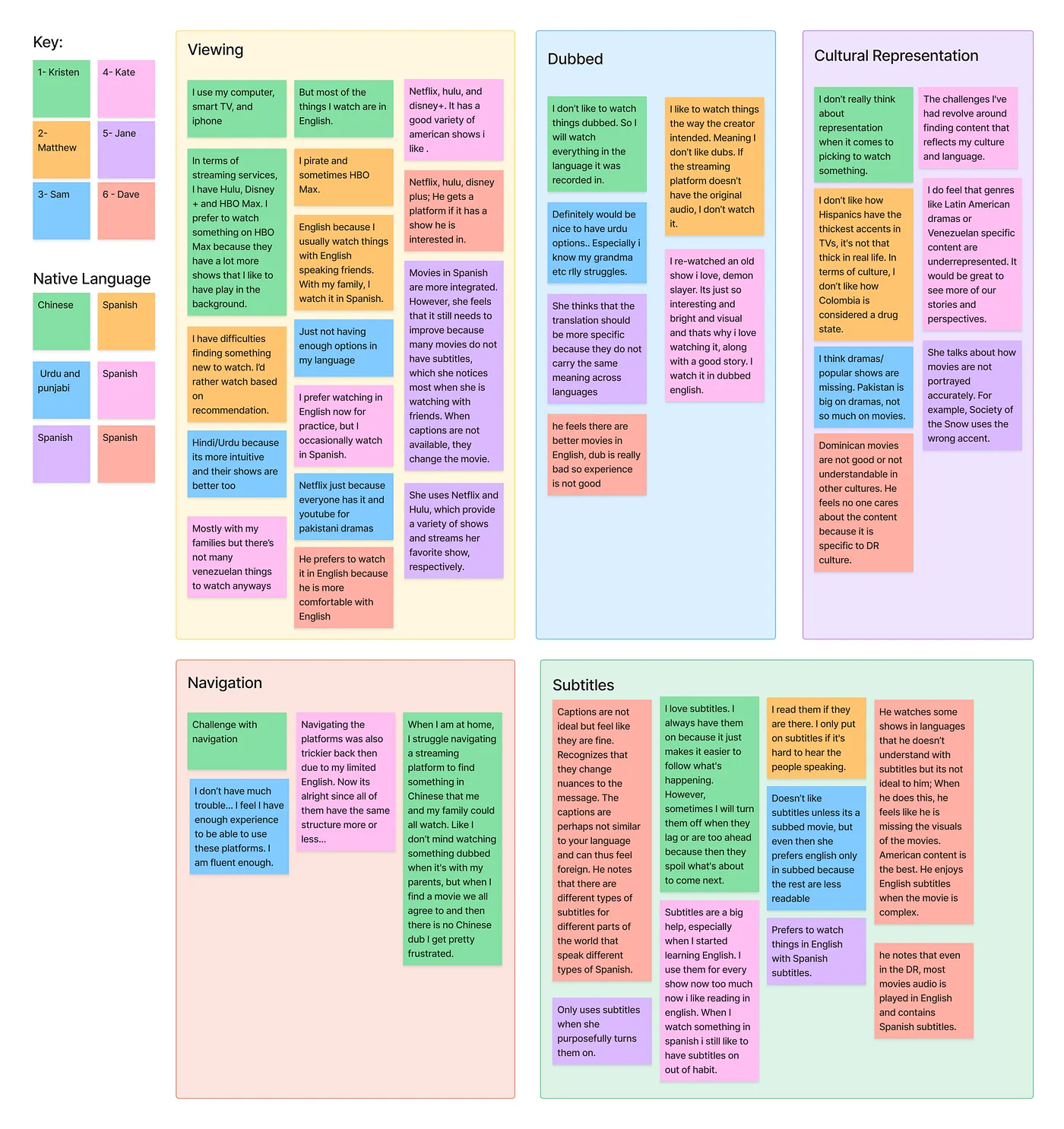
Observed 5 female participants in natural streaming environments (dorms, study lounges, and transit) to capture authentic, unprompted viewing behaviors. Participants spoke Chinese, Hindi, Tagalog, Twi, and Urdu, providing diverse perspectives on the streaming experience
View Ethnographic Study Plan ↗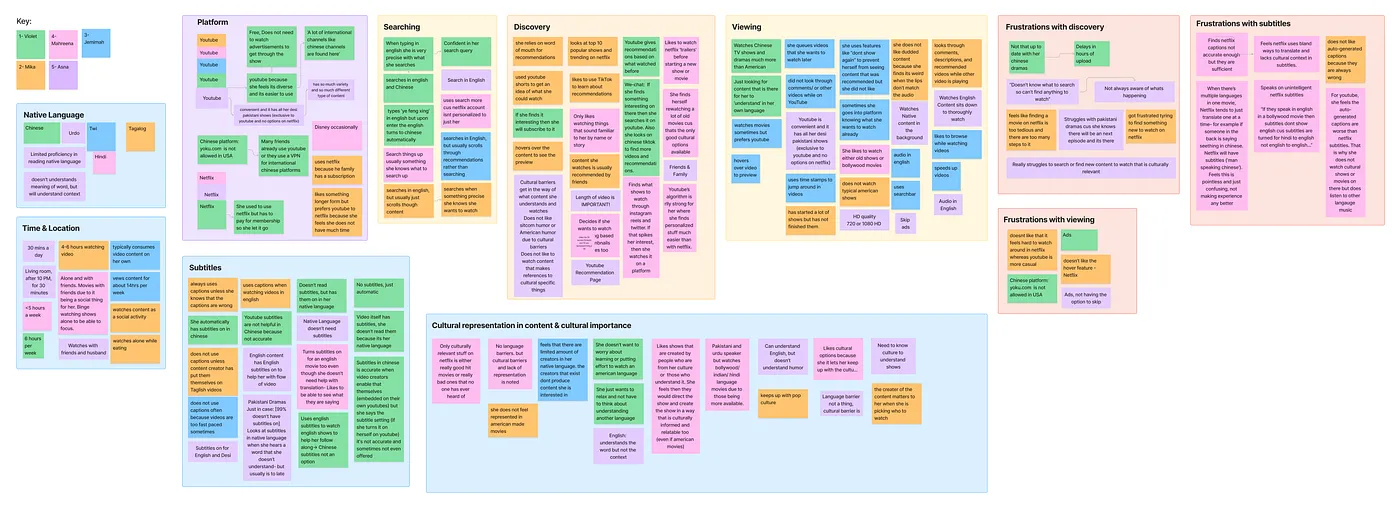
Facilitated two collaborative co-design workshops with 8 participants (6 female, 2 male), each session including four participants with diverse native languages: Chinese, Hindi, Spanish, Tagalog, Twi, and Urdu. This approach ensured participants’ voices were directly incorporated into the design process.
View Workshop Plan ↗.png)
Cultural representation and relevance, rather than language fluency, are the primary factors influencing non-native English speakers’ engagement and enjoyment of streaming content, supporting the theory of cultural proximity.
We chose Netflix due to its popularity among participants and focused on platform-based solutions to better support identity and personalization. Based on our research, we propose the following features:
We introduced cultural notes, a new feature that provides brief explanations of cultural references beneath subtitles. Users can toggle notes on or off and expand them for more detail, making content easier to understand and more engaging.
We renamed “Browsing by Languages” to “Browsing by Country,” allowing users to filter content by country. Participants felt this strengthened their cultural identity and sense of belonging.
Participants struggled with caption readability due to text size, color, and contrast. We’ve added customization options for background, color, font, and size to support a more inclusive, personalized viewing experience.
Created a video highlighting the new features in a potential Netflix update that include cultural notes, caption customization, and country-based browsing.
Used multiple research methods and the literature review to better understand non-native English speakers’ needs and guide design decisions.
We would improve the study by ensuring more balanced gender representation to better reflect the diversity of non-native English speakers
We would continue refining the high-fidelity prototype and conduct user testing to identify areas for improvement and better address user needs.


.png)